
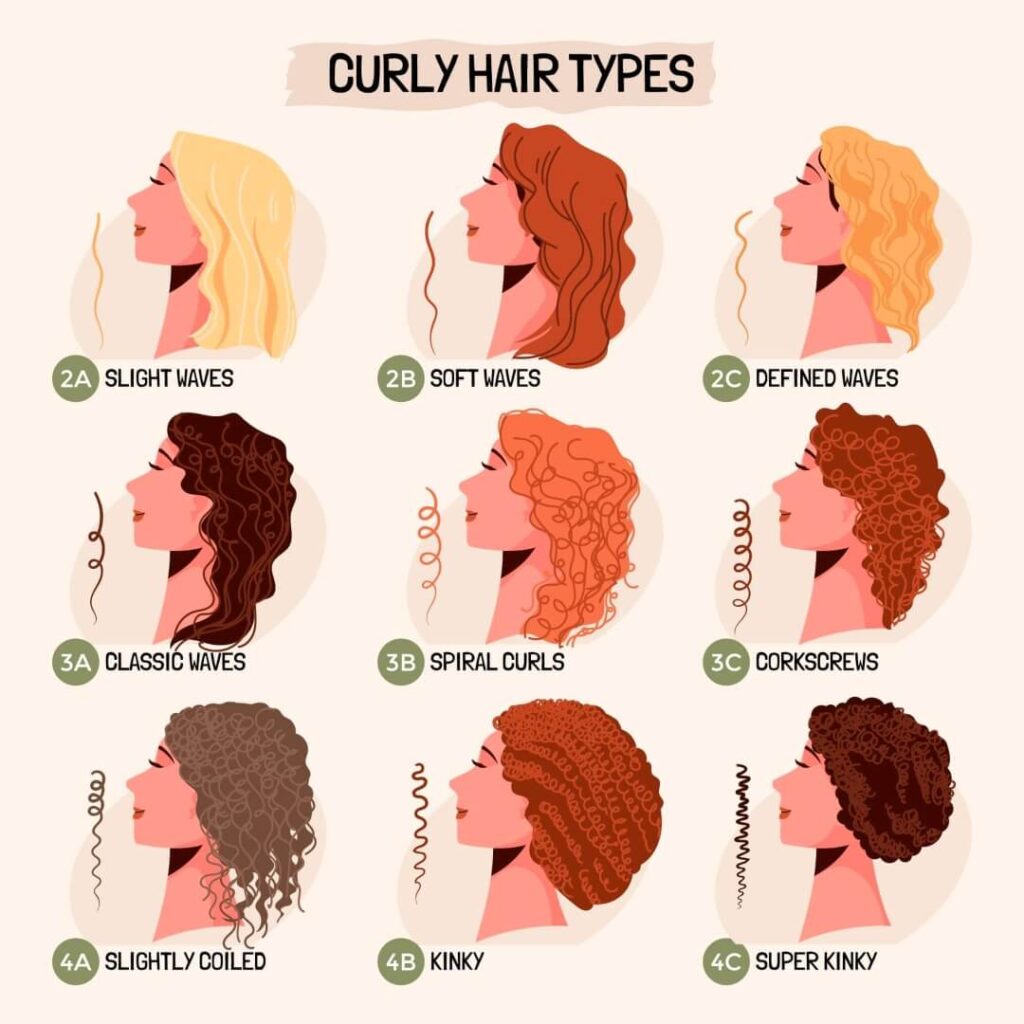
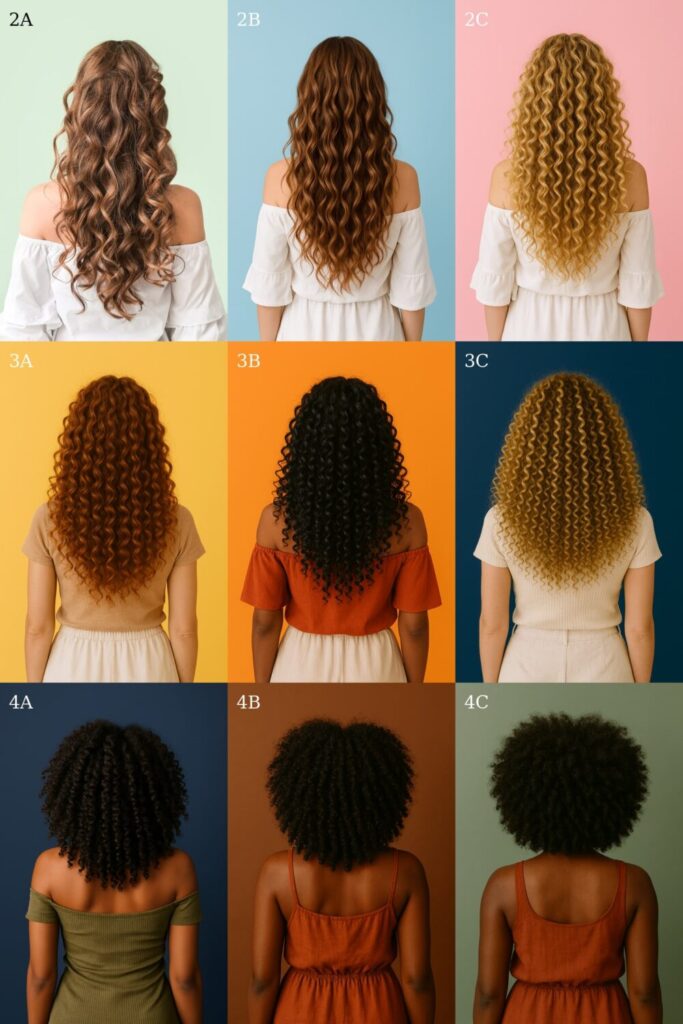
That distinction matters more than most people realize.
From a scientific standpoint, curl patterns (straight, wavy, curly, coily) are visual outcomes created by follicle shape, internal bonding and strand geometry.
What curl type does not reliably tell you is how that strand will:
- Absorb and retain water
- tolerate manipulation
- respond to products
- change with environment
Think of curl type like handwriting style.
Two people can write the same letter “S.” One presses lightly. One presses hard. One writes fast. One writes slowly.
Same shape. Completely different performance.
Originally, curl typing wasn’t meant to be a rulebook for hair care. It was created by Andre Walker (Oprah Winfrey’s stylist) as a stylist’s visual reference, not a complete system for understanding hair needs. Over time, it became popular because it gave people language and visibility, especially for textured hair, but it was never designed to explain WHY hair does what it does.
It’s also completely normal to have more than one curl pattern on the same head. Different areas of the scalp can produce different shapes, and that variation is part of how hair grows not something to “fix.”
So curl pattern is worth knowing, it tells you: how hair coils how tight the pattern appears how curls group visually
But curl typing does not tell you:
✘ why hair frizzes instantly
✘ why styles fall flat
✘ why moisture disappears
✘ why protein helps one person and harms another
And this is where frustration begins.
And that leads to the real question:
If curl type explains shape… what explains how hair behaves day to day?
2 — What Actually Explains Day-to-Day Hair Behavior?
Your hair responds to properties, not labels.
Hair properties describe how hair performs under pressure – water, product, friction, time, and environment.
If curl type is what you see…
Properties are what you experience day to day.
Frizz. Dryness. Breakage. Softness. Definition loss.
Those experiences don’t come from curl pattern. They come from how the strand interacts with its environment.
So the next question becomes: Which properties are actually responsible for common hair struggles?
3 — The Hair Properties That Control Frizz, Dryness, and Breakage
Let’s break down the key properties that directly influence product results and daily hair behavior.
Porosity — The Door System
Porosity describes how easily moisture enters and exits the hair. It’s determined by how open or compact the cuticle layer is.
Imagine your hair as a building with doors:
- Low porosity = hair has tight, sealed doors
- water enters slowly
- products sit on the surface
- moisture stays longer once inside
- High porosity = hair has open doors
- water rushes in
- water escapes just as fast
- hair dries quickly and frizzes easily
Now picture two people with the same curl pattern.
One complains: “My hair never absorbs product.”
The other says: “My hair feels dry again five minutes later.”
That difference isn’t curl type. It’s porosity.
Porosity heavily influences frizz, dryness, product absorption and longevity of styles.
Density — The Crowd Size
Density describes how many strands grow on your scalp. Density is not thickness. It answers the question: “How full does my hair appear?”
Think of density like a crowd in a room:
- a small gathering = low density
- a packed concert = high density
Density affects volume, scalp visibility and how much product you actually need.
This is why:
- some people need more product simply because they have more hair
- others feel overwhelmed by the same amount
Texture (Diameter) — The Rope Strength
In everyday language, we often use texture to describe how hair feels: smooth, rough, silky, or coarse to the touch. That’s understandable, but scientifically, that’s not what hair texture means.
Hair texture refers to the thickness of each individual strand — also called strand width or fiber diameter.
Hair is generally classified as fine, medium, or coarse based on how thick each strand is, not how much hair you have on your head.
This is different from hair density, which describes how many strands grow per square inch of scalp. You can have fine hair with high density, or coarse hair with low density, and those combinations behave very differently.
Picture ropes, thin rope breaks easily while thick rope can hold weight.
Fine hair:
- breaks more easily
- gets weighed down quickly
- needs lighter layering
Coarse hair:
- tolerates heavier products
- needs more lubrication
- resists damage
Two identical curls. One loves heavy creams. The other one collapses.
That difference lives in strand width, not curl type.
Elasticity — The Rubber Band Test
Elasticity is how hair stretches and rebounds without breaking.
Healthy hair behaves like a good rubber band: stretches, returns and doesn’t snap.
Low elasticity hair, breaks easily and feels stiff.
Overstretched hair feels mushy and won’t hold shape.
Elasticity explains:
- breakage
- curl definition loss
- why hair feels “off” even when moisturized
Strength — The Load-Bearing System
Strength is the hair’s ability to resist breaking under stress — brushing, detangling, tension, styling, time.
If elasticity is how hair stretches,
strength is how much stress it survives.
Hair strength is influenced by:
- Texture (diameter): thicker strands are mechanically stronger
- Elasticity: hair that stretches and rebounds resists snapping
- Cuticle integrity: an intact cuticle protects the cortex
- Protein structure: keratin reinforces the strand internally
- Damage history: heat, bleach, friction, and tension weaken strength over time
That’s why fine hair can be strong, and coarse hair can be weak.
Weak strength doesn’t always look dramatic. Often, it shows up quietly as:
- hair breaking during detangling
- ends thinning over time
- curls that won’t retain length
- hair snapping even when it feels moisturized
This is where many people get confused.
They think: “My hair is dry.” But the real issue is: “My hair can’t tolerate stress.”
Strength explains why:
- moisturizing products help some people and worsen breakage for others
- protein treatments feel miraculous for one person and disastrous for another
- curls look defined but fall apart within hours
So now we understand the properties.
Which leads to the next question: Why does the same product still give completely different results?
4 – Why does the same product work beautifully for one person and fail for another
Person A and Person B with same curl pattern, same routine and same products.
Person A
- hair absorbs slowly
- feels dry easily
- needs frequent moisture
Person B
- hair absorbs instantly
- feels limp quickly
- gets buildup fast
What changed?
Not curls. Not products. Properties.
Curl pattern told them what their hair looked like.
Properties told them what their hair needed.
This is why advice feels inconsistent.
This is why routines fail.
This is why people think their hair is “difficult.”
It isn’t. They’re just reading the wrong signal.
So the final question becomes: How do I choose products correctly?
5 — How to Choose Products the Right Way
Hair doesn’t “need everything.” It needs support where the system is leaking or overloaded.
Let’s take concrete examples to figure out how to choose products the right way.
Problem 1: Hair feels dry no matter what you use
Property involved: Porosity
What’s actually happening:
Water is escaping too fast (high porosity) OR struggling to get in (low porosity).
How to tell the difference:
- Feels dry minutes after washing → high porosity
- Takes forever to get wet, products sit on top → low porosity
How to choose products:
- High porosity hair
- Look for: film-formers, light oils, conditioning polymers, proteins
- Why: they help slow water loss and reinforce the cuticle
- Low porosity hair
- Look for: lightweight, water-based formulas, heat-activated conditioners
- Why: they help water get in instead of piling up outside
 Same “dry” feeling. Completely different solutions.
Problem 2: Frizz shows up instantly (especially in humidity)
Property involved: Porosity + Elasticity
What’s actually happening:
The cuticle isn’t sealing consistently, so the hair keeps reacting to moisture in the air.
Frizz is not chaos. It’s over-responsiveness.
How to choose products:
- Look for:
- Humectants (Glycerin, Aloe vera..ect) paired with sealers (not humectants alone)
- Anti-humidity or film-forming ingredients
- Avoid:
- Very light, watery products alone if your hair frizzes easily
Problem 3: Curls go limp or fall flat
Property involved: Texture (texture) + Density
What’s actually happening:
The hair can’t support the weight of the product you’re using.
How to choose products:
- Fine strands
- Look for: foams, light gels, lotions
- Avoid: heavy butters and thick creams
- Coarse strands
- Look for: richer creams, heavier conditioners
- Avoid: ultra-light formulas that don’t give enough support
Problem 4: Hair breaks easily or won’t hold definition
Properties involved: Elasticity and Strength
What’s actually happening:
The hair’s stretch–recovery system is out of balance.
It either:
- doesn’t stretch enough → becomes brittle
- or stretches too much → becomes weak and unstable
Both situations increase breakage and cause curls to lose definition.
How to choose products:
- If hair snaps easily and feels stiff:
→ Primary issue: Low elasticity
→ Look for: moisture-forward formulas, conditioning agents
→ Go easy on: protein-heavy products - If hair feels overly soft, mushy, or won’t hold shape:
→ Primary issue: Low strength (protein loss)
→ Look for: strengthening ingredients, hydrolyzed proteins
→ Avoid: over-moisturizing without reinforcement
Problem 5: Product works for others but not for you
Property involved: Density + Texture + Porosity
What’s actually happening:
You’re copying how much product and how it’s applied, without matching how much hair you have or how your hair handles product.
- Density (how much hair you have) controls how much product you need.
- Texture (fine vs thick strands) controls how heavy a product your hair can handle.
- Porosity (how your hair absorbs product) controls how product behaves on your hair.
When a product “doesn’t work,” it’s usually not the product.
The Big Takeaway
Curl pattern tells you how hair curls.
Hair properties tell you how hair lives.
Stop shopping by curl type and start shopping by response.
The shift is simple, but powerful.
Instead of asking: “What curl type am I?”
Start asking:
- How fast does my hair absorb water?
- Does it feel stiff or overly stretchy?
- Does it get weighed down easily?
- Does it lose moisture quickly?
- Does volume come from strand size or strand count?
These questions move you from classification → interpretation.
When you choose products that support porosity, strand width, density, and elasticity:
You stop chasing trends.
You start supporting biology.
Once you understand that difference, hair care stops being emotional and starts being logical.
Your hair has never been confusing.
You were just taught the wrong language.